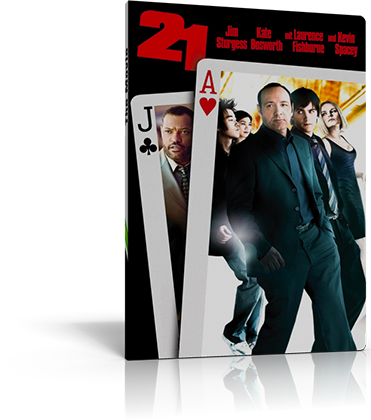
Reversion to the Mean - Card Counting

The mean or the average of the count in blackjack is zero as there are an equal number of low cards and high cards in any shoe or complete number of decks.  The further away the count is from zero, the stronger the tendency that it will move back toward the mean.  Professional card counters gain an advantage by wagering larger bets during positive deviations in the count when there is a greater probability that favorable high cards will be dealt as the count returns to its center of zero.

In the financial world, conventional wisdom is to buy when a  stock is undervalued and to sell when the price is  high. The law of regression to the mean states that probability wise, extreme values are more likely to be followed by less extreme values. Reversion trading is based on buying or selling stocks that are out of line with their “normal” pricing. Traders profit when  market prices return to their average just as card counters do when positive counts move back to the mean count of zero.

Although reversion trading is based on mathematical law, there’s no guarantee that this approach will yield a profit. The million dollar question is what is the true mean of a stock or commodity?  Variables used to forecast the market such as P/E ratios, interest rates, and investor confidence, just to name a few, are constantly changing.   In addition to the ever changing nature of market variables, another challenge is determining the appropriate time horizon for the mean price. Many traders have learned the hard way that  models that were successful in the past may no longer produce a profit, or may have been an aberration that was the beneficiary of chance.

In the game of 21 as well as the financial markets, it is possible to forecast the future and capitalize on deviations from the mean if the key variables are captured and weighed properly and the true mean  and its corresponding time horizon are determined.  As compared to the financial world, blackjack offers a static predictive measure (the count), as well as an explicit mean and time horizon. Unlike a stock or commodity, in 21, what goes up truly must come down.  This makes the return on investment in blackjack unmatched by that of any trading model in the financial world.

{ 0 comments }

The Big Score

by Mike Aponte on May 17, 2011

In the minds of gamblers, the dream of striking it rich far outweighs the reality of the less than favorable odds.  Nowhere is this more apparent than with the lottery. The odds  of winning the lottery are astronomically low  but when you factor in the millions of tickets that are sold, sooner or later someone will most definitely win.   Last month a high roller in Atlantic City hit the blackjack equivalent of  winning the lottery when he pulled in nearly $6 million. The odds, although slim,  were much greater as compared to the lottery  – especially when you factor in that he was playing at a $50,000 limit table.  However rare, it’s stories like this that drive people to gamble at the blackjack tables and purchase lottery tickets.

{ 0 comments }

Playing With House Money

by Mike Aponte on April 12, 2011

Playing With House Money

On a riverboat casino I once witnessed a 21 year old kid parlay a $25 buy-in into $1000 in less than an hour.  As his chip pile grew so did his grin, and he insisted on high fiving me repeatedly.  I was happy for him but I was hoping he would take his money and run.   Instead, he tried to ride his luck even further – even increasing his wagers to $200, $300 a hand. He was playing with “house money” and he figured he had nothing to lose. However he did have something to lose and unfortunately the story had an all too familiar ending.  He hit a bad run and gone was his $1000 grin.

This is a common phenomenon among gamblers.  When they’re lucky enough to be up on a casino, rather than quitting while they’re ahead or  keeping the size of their wagers at a modest level, they become loose in their play and they take on even more risk.  There’s a disconnect between the perceived value of their gambling winnings and their actual value.  But $1000 is a $1000, regardless of whether it’s casino chips or a paycheck.

In behavioral economics, the tendency to value some dollars less than others is called “mental accounting”. This concept was developed by Professor Richard Thaler of the University of Chicago.  People tend to place gambling winnings in the category of “bonus” or “found” money.  People are  more likely to waste their tax refund or gift money as opposed to income earned on the job.

What contributes to gamblers placing less value on house money is the use of casinos chips.  The value of casino chips are cheapened in much the same way that credit card dollars are because there is seemingly no immediate loss of money. For some, credit cards and casino chips are like monopoly money.  Shoppers are much more likely to spend beyond their budgets on credit card purchases as compared to cash purchases.  When buyers  fork over cash, the value of of their hard earned money hits home.  In casinos it’s easier for gamblers to risk hundreds, even thousands of dollars when they’re pushing out chips instead of cash.

So the next time you’re fortunate enough to be winning at the blackjack tables, or receive a tax refund or bonus check, be sure to  keep your mental accounting in proper perspective.  If you don’t, it can be very detrimental to your financial well being.

{ 0 comments }

The Monty Hall Problem and Card Counting

by Mike Aponte on August 3, 2010


Monty Hall - 3 Door Problem and Card CountingIn the movie 21, Professor Mickey Rosa poses an interesting puzzle to his class – The Monty Hall Problem.  Imagine you’re on a game show and the host presents to you three doors.  Behind two of the doors are goats.  Behind one of the doors is a car. Choose the correct door and you win the car.  Let’s say you choose Door #1.  The host, who knows what’s behind all the doors, opens  Door #3  and reveals a goat.  The host then offers you the choice of staying with Door #1  or switching to Door #2.   Should you switch doors at this point?  To answer this question you must first determine the probability of choosing the car and the probability of choosing a goat.

At first blush it may seem that it’s basically a coin flip.  After all there are two doors left, one of which will reveal the car.   Either door would be a 50/50 proposition, right?  Well,  as counter intuitive as it may seem, if you switch doors  you would  double your odds of winning.  Many people emphatically believe  that after Door #3  is eliminated, the odds of wining and losing are equal.    This would be true if there were only 2 doors to choose from at the start of the game.  But, the game began with three doors which means that when you selected Door #1, you had a 1 in 3  chance of winning the car and a 2 in 3  chance of getting a goat.  If you stick with your original pick of Door #1, those odds of winning and losing remain the same.

However, if you choose to switch doors, your odds of winning increase dramatically.  The key to this problem is that the host knows where the car is and will only open a losing door.  If you switch doors, you will win if the car is behind Door #2 or Door #3 because the host will always open a door that has a goat behind it.  You essentially have two shots at winning.   By switching, you  would only lose if the car happens to be behind Door #1.

In summary, if you stay with Door #1  you have a straight 1 out 3  chance of winning the car and a 2 out 3  chance of claiming a goat.  If you switch doors you will win if the car is behind Door #2 (1/3)  or Door #3  (1/3).  Adding these two probabilities yields a 2/3 chance of winning and a 1/3 chance of losing.  The Monty Hall Problem illustrates an important principle of card counting.   Card counters use information gained from the cards as they are dealt to update the constantly changing odds of the game.  In order to earn a long term profit, a good card counter must capitalize on this  by betting proportionally larger amounts relative to player advantage – in the same way Ben Campbell correctly chose to switch doors after determining that it would increase his odds of winning.

{ 1 comment }

Betting Progressions: Fool’s Gold of Gamblers

by Mike Aponte on April 22, 2010

Many gamblers are intrigued by betting systems  based on the amount wagered and the outcome of the previous hand.   These  systems, which are touted in some books and all over the internet,  are betting progressions – the  most popular of which is the Martingale.   With the Martingale system you start off with your base bet, and if you  lose, you double your wager.  You continue to double up your bet with each loss until you win, at which point you return to your base unit.  If your hand pushes with the dealer, you  wager the same amount.  This approach produces a high percentage of small profit sessions.

This system may seem like a fool proof way to beat the house.  After all,  the odds of losing 7 or 8 hands in a row are slim.  As long as you finish a session after a winning hand,  you will walk away a winner.  But,  all progression bettors learn the hard way that  sooner or later you will get wiped out.  Eventually  you will lose 7, 8, even 10 or more consecutive hands and your session will end with a devastating loss.   When a progression runs into an  inevitable unlucky streak, the result is  financial ruin.   For example, if a Martingale bettor with a $10 base unit  loses 10 straight hands, he would  drop $10,230.  When you’re doubling your bet everytime you lose,  it doesn’t long for a small base bet to become a huge bet you can’t afford to lose. If you play long enough, at some point you will be hit with a painful  losing streak.  I know this all too well, having once lost  14  straight hands in Atlantic City.  If I had been utilizing a betting progression, the result would have been disastrous.

Betting progressions could work in a hypothetical world.   If you had an infinite bankroll and played at a casino which offered an  infinite table maximum, you would be able to whether the storm of any losing streak,  without fear of going broke or being constrained by a table max.  In  the real world however, gamblers play with a limited bankroll and table max’s are far from infinite.  House edge is what rules.  Simply stated – whoever has the advantage will come out on top. All casino games have a built-in edge for the house which is immune to betting progressions.   Due to their simplicity and often positive, short term results, betting progressions may be appealing to unsuspecting gamblers, but unlike card counting and other forms of advantage play, they do not hold up to the unforgiving laws of probability.

{ 2 comments }

How Important is the Burn Card in Blackjack?

by Mike Aponte on February 3, 2010

At most casinos the dealer must “burn” the first card of a shoe by placing it directly in the discard tray before any cards are dealt.  In Atlantic City the Blackjack - Burn Card in Discard Trayburn card is usually shown before it’s taken out of play, but what about when the burn card isn’t revealed?  This  seems to cause angst for some blackjack players (“that could have been my ace”), but what  impact does it really have on the game?  For the vast majority of blackjack players who aren’t keeping track of the count, it has no effect whatsoever.  From a card counting perspective, when the dealer burns a card  it’s equivalent to moving the cut card up by one.  For example, if the cut card is placed at a deck and a half (78 cards), the burn card effectively moves the cut card to 79 cards. There’s simply one more unknown card. For both card counters and the average gambler, the impact is insignificant at best.

If burning the first card doesn’t serve as an effective measure against card counting, why do casinos employ this practice?  The purpose of burning a card is to protect against the steering of the top card.  If a card is exposed when the cards are presented to players to cut, the exposed card can be cut into play.  Steering an ace to your self is worth a whopping 51% in expected win.  Cutting a ten to self is worth a not too shabby 14%.  Card steering is completely legal if the card information is obtained due to the dealer unknowingly exposing a card.  The illegal acquisition of card information is what casinos are really concerned about. Cheaters can mark tens and aces, making them recognizable when they end up at the top of the shoe.  There’s also the possibility of collusion with the dealer who either flashes the top card to fellow accomplices, or peaks at it and then passes on the information. The bottom line is, even if you’re counting there’s no need to fret about an unseen burn card.  Essentially,  all the dealer is doing is moving the cut card up by one.

{ 0 comments }

Stop Gambling and Start Investing

by Mike Aponte on January 20, 2010

Gambling versus Investing

Professional gambler has always been a moniker that makes me twinge.  As a card counter, I have never considered myself a gambler.  Investor is a much more fitting title for a professional card counter.  Some may say that this is an insignificant matter of semantics.  After all, both gamblers &  investors put their money on the line with the goal of making a profit. However, there is a big difference between the approaches & outcomes of a gambler as compared to an investor.

These are the traits of a gambler:

1)   A gambler does little or no research & preparation before taking on risk.

2)   A gambler hopes to win despite unfavorable odds.

3)   A gambler acts based on hunches, misinformation &  unproven systems.

4)   A gambler is affected by the emotions of greed &  fear.

5)   A gambler’s motivation is largely driven by thrill seeking &  entertainment.

6)   A gambler loses.

Conversely, these are the traits of an investor:

1)       An investor completes thorough research &  preparation before taking on risk.

2)       An investor knows he/she has a high probability of winning (making money) because the odds are in his/her favor.

3)       An investor utilizes a rational &  proven model or system.

4)       An investor does not allow emotions to influence his/her decisions.

5)       An investor’s motivation is not risk seeking &  entertainment.

6)       An investor wins.

These characteristics hold true not only in blackjack, but in just about any potential gamble/investment, whether it’s the stock market, poker, real estate or buying a fast food franchise. Gamblers tend to have a narrow, short-term view of risk versus reward, focusing primarily on the upside. On the other hand, investors see the big picture &  factor in risk when evaluating the long-term prospect of an investment. Of course even the savviest investment has an element of chance. But, if you have the right mindset &  implement a  rational, proven approach, you will maximize your odds of success.

{ 6 comments }

Hit Soft 17 – Friend or Foe?

by Mike Aponte on April 17, 2009

Most blackjack players are oblivious to whether the dealer stands or hits on soft 17.   The dealer stand on soft 17 rule has always been the standard, but a growing number of casinos now require the dealer to hit on soft 17 (hands like Ace, 6). Not only do most players fail to recognize the difference, some believe the hit soft 17 rule works in their favor since the dealer will bust more often.  The dealer will bust more often, but the dealer also has the opportunity to improve on a weak total of 17.  The reality is the dealer will improve his hand often enough that it will more than offset the increase in dealer busts.  It’s not a good feeling when you have 20 and the dealer hits on a soft 17 and pulls 21 to wipe out the table.

Below are the dealer outcome probabilities for a 6-deck shoe for the stand soft 17 rule versus the hit soft 17 rule.*

18 19 20 21 Bust

Stand Soft 17 14.62% 14.04 18.85% 7.65% 29.60%

Hit Soft 17 14.82% 14.24 19.06% 7.86% 30.00%

As you can see, when the dealer hits soft 17 rule is in effect there is a greater probability the dealer will draw to 18, 19, 20, or 21.  The net result of the hit soft 17 rule is that it adds .22% to the house edge.  All else being equal your odds are better when the dealer stands on soft 17.

* Probabilities rounded to the nearest one hundredth of a percent. With the dealer stands on soft 17 rule, the probability of the dealer drawing to 17 is 15.25%. With the dealer hits soft 17 rule, the probability of the dealer drawing to a hard 17 is 14.02%.

{ 7 comments }

Even Money: Is Insurance a Sure Thing?

by Mike Aponte on April 10, 2009

As the dealer lays down your second card, a smile grows across your face. You just got blackjack. A moment later your smile fades. The dealer has an ace showing. She calls out for insurance bets. Before the dealer checks the hole card, she makes eye contact with you, awaiting your decision. The player next to you advises, “I would take it. Even money is the smart move. ” The dealer agrees. “Always take insurance when you have blackjack. It’s a sure thing.”

To take insurance or not take insurance. It’s a decision that becomes tougher for players when they have a good hand, particularly blackjack. The more money on the line, the more likely players are to take insurance. This is where players go wrong. Insurance is not a wager you should take to “protect” your original bet. It is striclty a side bet on whether or not the dealer has a ten or face card in the hole. Players can insure their bets by placing an amount up to half their wager in the insurance area on the table. If the dealer does have a ten or face card in the hole, the bet pays off 2 to 1.

Let’s break down the expected win of insurance for a 6-deck shoe. When the dealer shows an ace, the odds she will have blackjack are 96/311. There are 96 ten-value cards in a 6-deck shoe and there are 312 total cards in a 6-deck shoe (52 x 6). Not counting the ace showing there are 311 cards remaining. There is a 96/311 chance that the dealer will flip over a ten or face card and pay off insurance bets 2 to 1. There is a 215/311 chance that the dealer will not have blackjack and all insurance bets will lose.

Based on a $100 bet, here is how the expected win works out.

(96/311) x ($200) + (215/311) x (-$100) = $(19200/311) -

$(21500/311)

$(19200/311) – $(21500/311) = -$(2300/311)

= -$7.395

Over the long run, for every $100 you wager on insurance you can expect to lose $7.395 . The insurance bet has a 7.395% house edge. To put this in perspective, the house edge on insurance is more than 14 times the edge versus a basic strategy player, playing at a .5% disadvantage. This is why one of the cardinal rules of basic strategy is never take insurance. So the next time someone tells you to take even money, remember, the only sure thing about insurance is that it will cost you a pretty penny over the long run.

Blackjack: What are the Odds?

{ 2 comments }

Blackjack: What are the Odds?

by Mike Aponte on April 2, 2009

Blackjack is the name of the game. So what are the odds of getting dealt a blackjack? The probability depends on how many decks are played. Of course the essential ingredients to blackjack are an ace and a ten-value card (10, jack, queen, or king). In a single deck game there are 4 aces and 16 ten-value cards. You can get blackjack in one of two orders:

1) A ten-value card followed by an ace

2) An ace followed by a ten-value card

If we add the probabilities of these two events, this will give us the odds of getting blackjack.

The odds of getting a ten-value as your first card is 16/52. 16 ten-value cards divided by the total number of cards in 1 deck. The fraction 16/52 reduces to 4/13. The odds of getting an ace as your second card are 4/51.   4 aces divided by 51 cards remaining. Multiplying 4/13  by  4/51  gives us the odds of getting a ten-value card followed by an ace.

1)   4/13  x  4/51  =  16/663

Looking at the second scenario, the odds of getting an ace as your first card is  4/52  (4 aces divided by 52 cards) which reduces to 1/13. The odds of getting a ten-value as the second card are 16/51.   16 ten-value cards divided by 51 cards remaining.

2)   1/13  x  16/51  =  16/663

Adding the probabilities of the two different orders in which you can get blackjack (16/663 + 16/663) yields the total probability of getting blackjack.

16/663  +  16/663   =   32/663   =   4.827 %

For a 6-deck shoe, the same principles apply but the number of cards changes. In 6 decks, there are 24 aces, 96 ten-value cards,  and 312 total cards.

1)   Ten-value cards / Cards Remaining   x    Aces / Cards Remaining

(16 x 6) / (52 x 6)    x    24 / (52 x 6) – 1

96 / 312    x    24/311  =  288/12,129

2) Aces / Cards Remaining    x    Ten-value cards / Cards Remaining

3/39    x    96311   =   288/12,129

The sum of the the two probabilities is 4.749%  which means that you’ll get blackjack once out of every 21 hands.

{ 5 comments }